New Study Confirms Movesense Wearable Sensor Matches Laboratory Force-Plate Accuracy
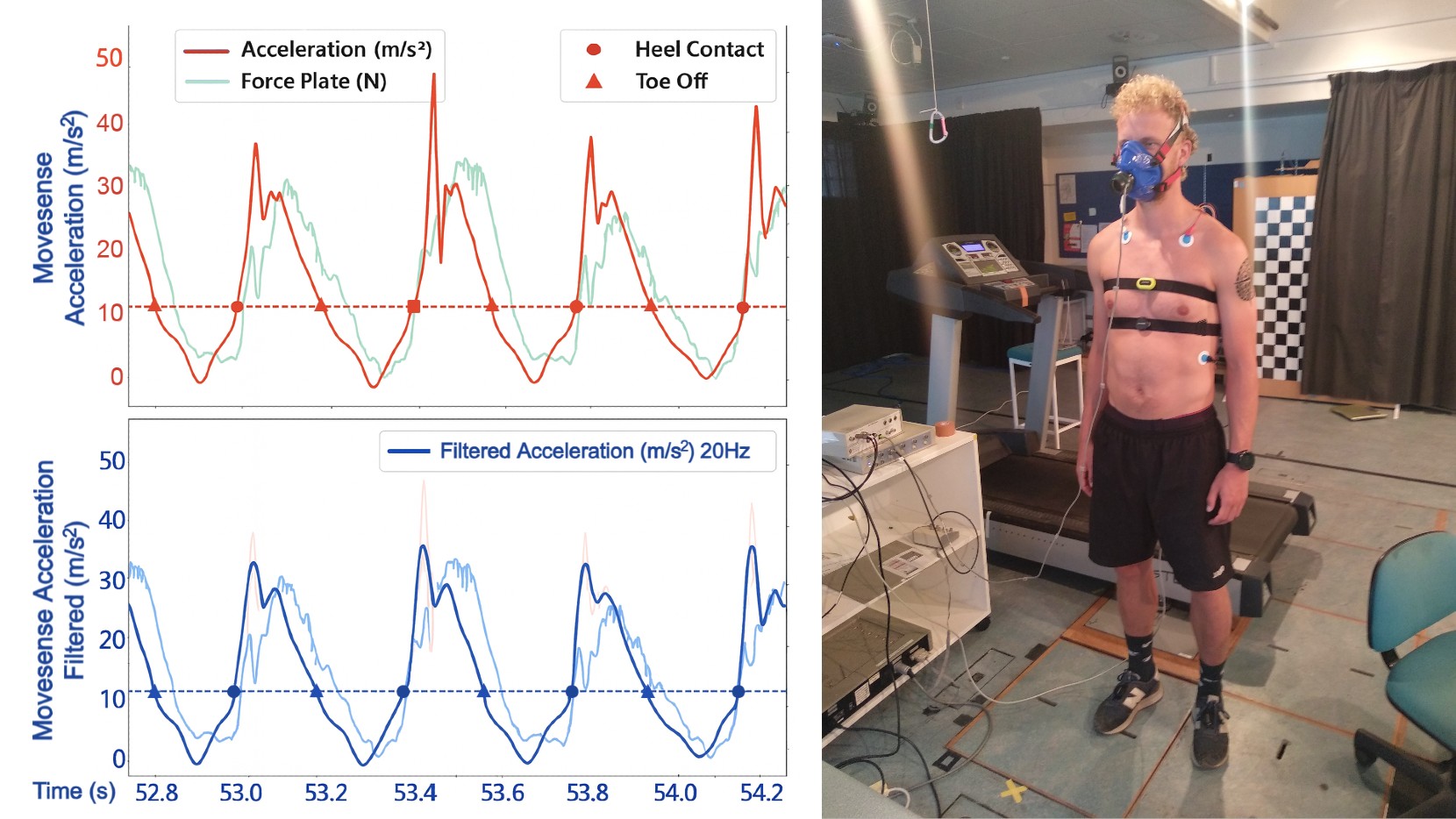
A recent study published in the Journal of Biomechanics shows that Movesense sensor, combined with optimized analysis algorithms, can measure step time and gait asymmetry with accuracy comparable to a laboratory-installed force-plate system. The article, Validation of step time and asymmetry detection algorithm in high-intensity running with Movesense IMU (Gómez et al., 2025), provides strong scientific support for using Movesense sensors in professional and clinical gait analysis applications.
These results validate a key advantage of Movesense sensors: they make high-quality biomechanical measurements accessible outside the lab, enabling real-world monitoring at a fraction of the cost of traditional force plates.
High agreement between Movesense IMU and force-plate reference system
The research team coordinated by Raúl Martín Gómez, University of Otago, Dunedin, New Zealand, compared step time and left–right asymmetry metrics captured by a wearable Movesense IMU (Inertial Measurement Unit) to the gold standard readings obtained from a high-precision laboratory force-plate setup.
In the study, participants performed an incremental running test until exhaustion, wearing a single, chest-mounted Movesense sensor with 208Hz IMU sampling. Their stride impact forces were simultaneously captured by a high-precision force-plate system, the established reference method in biomechanics research.
The new study shows that:
- Step-time measurements derived from the Movesense sensor had an excellent agreement with the force-plate results. The mean difference was 0 ± 6 ms (r = 0.97) across all 33,477 steps.
- Asymmetry detection accuracy was high, confirming the robustness of the IMU-based algorithms developed by the team. All (100 %) left and right foot strikes were correctly identified. The step time imbalance mean difference was 0.1 % ± 0.1 % for the 103 speed-by-participant subsets.
- The Movesense sensor can provide highly reliable data during natural walking and running tasks, without requiring a controlled lab environment.
- The agreement between Movesense and force-plate system is strong enough to support scientific and clinical use as well as commercial applications.
Real-World Advantages for Clinicians, Researchers, and Developers
The results mean that clinicians, sports scientists, and researchers can confidently use Movesense sensors for gait monitoring, rehabilitation assessment, and performance analytics without expensive lab hardware. This also opens great opportunities for companies and individual developers who want to create new innovative products for biomechanical applications in the field.
Since the IMU implementation of the Movesense HR+ sensor used in the study and the medically certified Movesense MD are identical, the study results can also be applied in clinical use with the Movesense MD sensor, a class IIa medical device (EU MDR).
Along with validating measurement accuracy, the study supports the usability advantages of Movesense sensors:
Lightweight and wearable: The sensor can be worn on different parts of the body as needed for each measurement, and it follows the user’s natural movement. Combined with the sensor’s ECG and heart rate monitoring capabilities, also with validated accuracy, it has the potential to become the personal, wearable performance lab for daily life and exercise.
Cost-effective: The scalable, low-cost sensor enables larger studies and frequent monitoring without expensive, lab-installed hardware. This is of interest in research, healthcare, and sports alike.
Easy to deploy: Movesense is suitable for clinics, home environments, running tracks, and research fields in a wide variety of use cases.
Developer-friendly: Open APIs, code examples, developer documentation and flexible integration options are a great starting point for new research tools and commercial products. With the option for factory-built white labeling, the path from a working prototype to a commercial mass market product is short and straight forward.
The study concludes that the Movesense IMU represents a feasible and effective solution for assessing key biomechanical parameters, bridging the gap between laboratory-grade accuracy and the practicality needed for broader applications.
The new validation results, combined with the usability benefits, strengthen Movesense’s position as a powerful tool for machine learning model development based on real-world IMU data. This can be leveraged in gait and mobility analysis, rehabilitation and physical therapy, injury prevention, neurological assessments, sports performance monitoring, biomechanics studies, and many more application areas in sports, health and well-being.