Beyond the ECG: Utilizing Seismocardiography to Study the Heart’s Mechanical Signature with Movesense MD
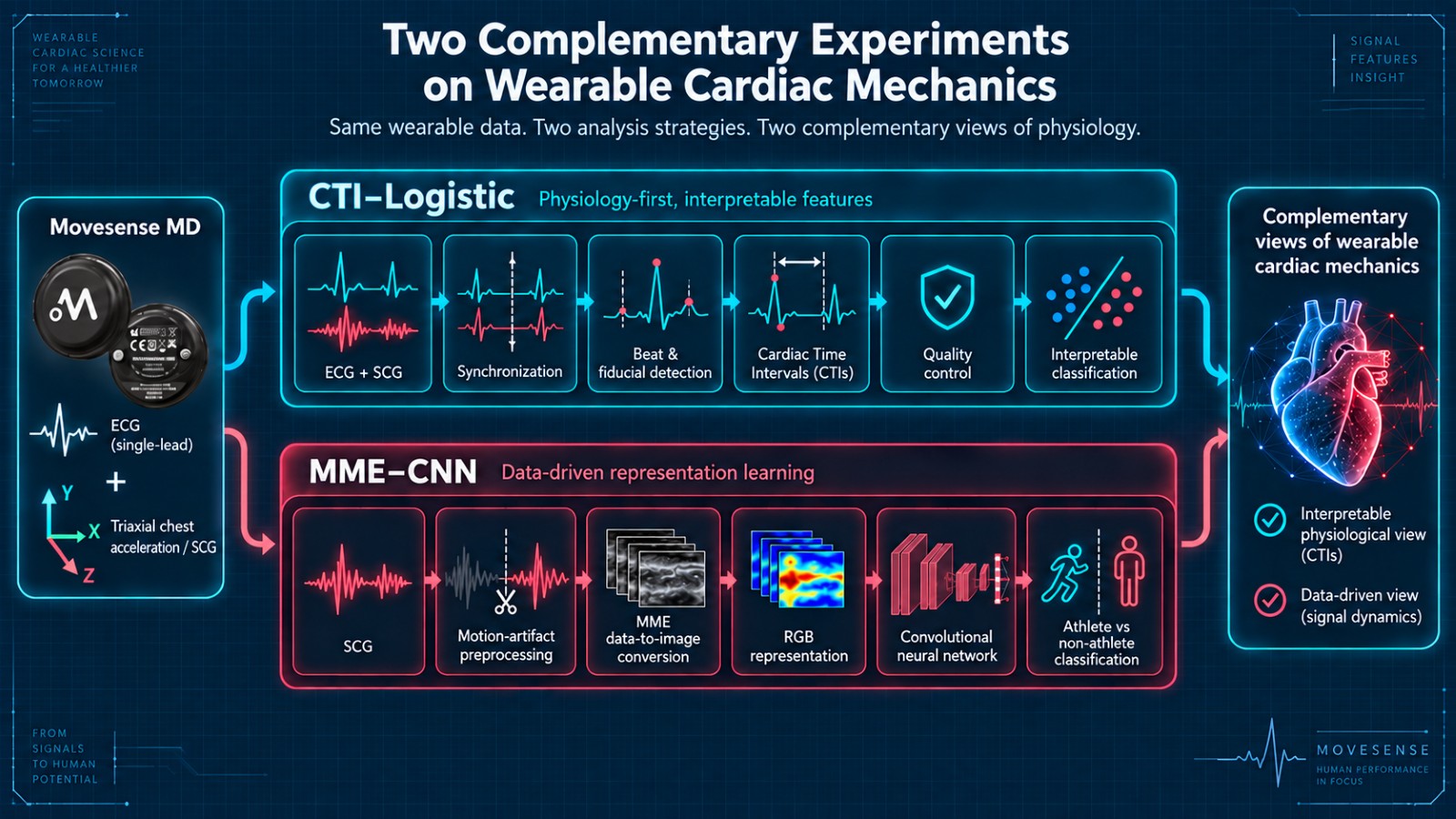
What if a wearable device could capture not only when the heart activates electrically, but also part of what happens mechanically as it contracts and relaxes?
This question was explored in two complementary bachelor’s research projects in the Supervenice unit at Ca’ Foscari University of Venice using the Movesense MD wearable sensor, equipped through the Movesense Academic Program.
Movesense MD can record a single-lead electrocardiogram (ECG) together with triaxial chest acceleration. ECG provides a well-established view of the heart’s electrical activity, while the accelerometer can record extremely small chest vibrations associated with the heart’s mechanical activity. Studying these vibrations is known as seismocardiography (SCG).
The research involved 12 healthy participants, six athletes and six non-athletes, measured under different postural and activity conditions. The aim was not to develop a clinical diagnostic system, but to explore what additional information could be obtained when electrical and mechanical sensing of the heart are available from the same wearable platform.
The challenge of measuring the mechanical heartbeat
One of the clearest lessons from the project was also one of the most practical: cardiac vibrations are tiny compared with ordinary body movement. Walking, exercise, breathing, changes in posture and variations in sensor contact can distort the SCG waveform or hide cardiac-related features. This makes wearable SCG substantially more challenging than simply using an accelerometer to detect large-scale movement.
In this dataset, static measurements generally provided the most reliable mechanical information, with the supine position being particularly informative.
This highlights an important engineering point: the sensor itself is only the starting point. Turning chest acceleration into useful cardiac information also requires careful signal processing, synchronization, quality control, and motion-artifact handling.
Two ways of looking at the same wearable data
The same overall dataset was then explored through two different analytical strategies.
The first, developed by Alessandro Boldrin under the supervision of Professor Giovanni Antonio Salvatore, followed a physiology-first approach. In this study, the electrical and mechanical signals were synchronized, individual heartbeats were segmented, and characteristic SCG features associated with mechanical cardiac events, such as aortic valve opening (AO) and closure (AC), were estimated from the chest-vibration signal.
These timings were then used to calculate Cardiac Time Intervals (CTIs), which describe the duration of different electrical, mechanical and electromechanical phases of the cardiac cycle. Mathematical, physiological and signal-quality checks were applied before further analysis.
The CTIs were then used to explore whether physiologically interpretable timing patterns could support an athlete versus non-athlete classification experiment using Logistic Regression with Elastic Net regularization.
For the internal CTI analysis and classification, 10 participants were used in a Leave-One-Subject-Out Cross-Validation framework, meaning that one participant was excluded from training at each iteration and used as the test case. Two additional participants were kept separate for a preliminary external check.
The goal was therefore not diagnosis, but to test whether wearable-derived cardiac timing contained interpretable information capable of distinguishing the two groups in this small-sample proof-of-concept study.
A parallel project by Karen Bianco, supervised by Professor Peppino Fazio, approached the same wearable recordings from another direction. Instead of defining physiological intervals in advance, SCG recordings were preprocessed, divided into windows and transformed into images using Mobility-to-Matrix Encoding (MME).
MME converts features related to position, velocity and acceleration into the red, green and blue channels of an RGB image. Those images were then processed by a Convolutional Neural Network (CNN), allowing the model to learn signal patterns automatically rather than relying on predefined physiological intervals.
Interpretable physiology and data-driven learning
These two approaches are not competing versions of the same model. The CTI strategy asks: Which physiologically meaningful timing features may differ between the groups? The MME–CNN strategy asks: Can useful patterns be learned directly from the SCG signal without defining those features beforehand?
Their validation frameworks were different, so their numerical performances should not be compared directly. One approach emphasizes physiological interpretability. The other explores data-driven representation learning. Together, they complement each other, and illustrate two different ways of extracting information from the same type of wearable measurement.
We will publish another article to discuss the results of the two projects.
From wearable signals to cardiac information
The broader lesson is that a wearable device capable of recording both ECG and motion adds seismocardiography to the researcher’s toolkit, offering an interesting experimental platform for studying the relationship between the heart’s electrical activation and its mechanical response.
Future work will require larger and more diverse cohorts, improved motion compensation, repeated measurements and stronger subject-independent validation, especially during everyday activities outside controlled environments.
Movesense MD also provides a gyroscope signal, enabling the use of gyrocardiography (GCG)—a non-invasive cardiac monitoring method that measures rotational micro-vibrations and angular velocities of the chest wall associated with the rotational movements caused by the beating heart.
In the longer term, combining interpretable cardiac timing with data-driven signal analysis could help wearable systems provide a richer picture of how cardiac function changes with posture, exercise, recovery and training.
Get a device for your own measurements*
* To monitor ECG with the Movesense MD, you will also need a chest strap or an adhesive patch to wear the sensor. Movesense ECG Recorder app is available free of charge for Android and iOS from app stores.
Text and image: Allessandro Boldrin